
A Local's Guide to Buying a Home in Jacksonville, FL
Jacksonville is not a city you can generalize easily. It's been a consolidated city-county government with Duval County since 1968, which means the city limits cover an enormous geographic footprint - more than 500 distinct neighborhoods spread across major sections like the Southside, Westside, and the Jacksonville Beaches.
The cost of living runs about 10% below the national average, which draws first-time buyers, relocators, and investors in roughly equal measure. But the city's size means the right neighborhood for you depends on your commute, your price range, and how you actually want to spend your weekends. Those are the things worth sorting out before you tour a single house.
The Jacksonville Housing Market Right Now
The median sale price in the Jacksonville housing market sits at around $317,000 as of mid-2026 - up nearly 4% year-over-year. That's steady appreciation without the kind of price shock you've seen in Tampa or Miami.
There are over 4,200 homes on the market right now, with about 3.9 months of supply. Homes are spending roughly 59 days on market before selling. You have time to be thoughtful here.
Median Home Prices and Market Trends
That $317,000 median is meaningfully below the national average, and it shows up in how negotiations actually go. Most homes are selling for about 98% of their list price - sellers are realistic, and standard back-and-forth still works.
Only about 18.5% of homes are selling above list price right now. You don't need to waive your appraisal contingency or throw a blind escalation clause at every listing to be competitive. Your agent should pull recent comparable sales and help you land on an offer that makes sense for the specific property.
Inventory Levels and Competition
A 3.9-month supply puts this market in roughly balanced territory, though it leans slightly toward sellers. Move-in ready homes in popular areas still draw multiple eyes - that's just reality in any healthy market. But there's no severe shortage forcing buyers into panic mode.
Over 1,000 homes sell here every month. The transaction volume is healthy, and well-priced listings move. If you need to sell your home in Jacksonville before buying, this balanced market provides a good window to time both transactions. When you find a property that checks your boxes, don't sit on it for a week. Act promptly and have your pre-approval ready.
Housing Types and Price Ranges in Jacksonville
The city's size is one of its defining traits as a real estate market. Because Jacksonville stretches all the way to the Atlantic Ocean, the inventory runs the full spectrum - historic bungalows, high-rise downtown condominiums, newer suburban developments, and waterfront estates. What you'll find in a given area depends almost entirely on where you're looking.
Set your budget before you start touring. It's the fastest way to eliminate half the map and focus your search.
Single-Family Homes and New Construction
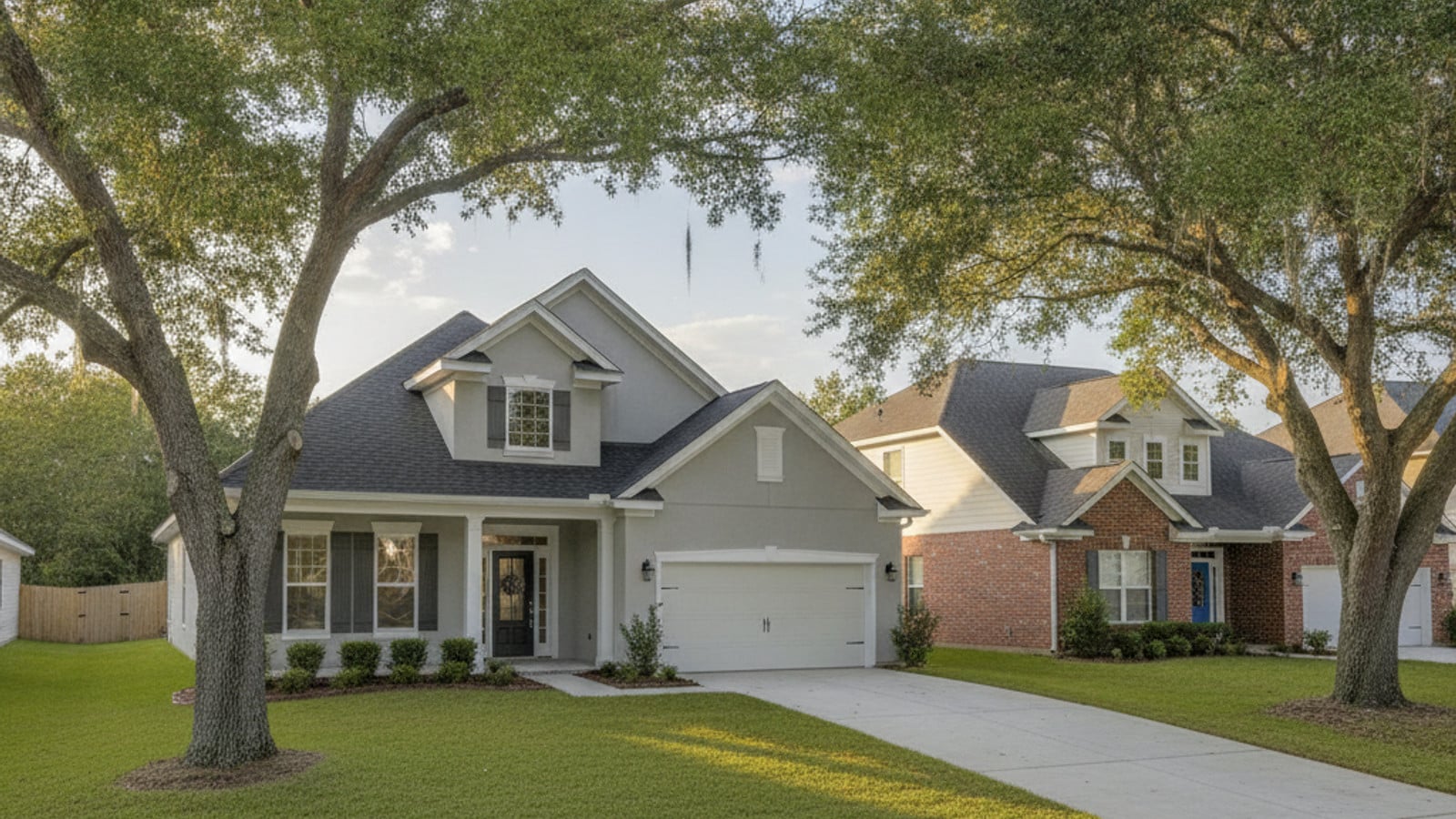
Single-family homes dominate the Duval County inventory. You'll run into mid-century concrete block homes, large estates shaded by mature oak trees, and newer suburban subdivisions - sometimes within a few miles of each other.
New construction is widely available, particularly in the southern and western parts of the county. Builders on spec homes will often throw in incentives - closing cost help, rate buydowns - so it's worth asking. Those deals can make a real difference to your monthly payment.
Condos, Townhomes, and Entry-Level Options
If you're looking at a lower price point or want less maintenance responsibility, condos and townhomes are plentiful near the urban core, the Southside commercial corridors, and out by the Jacksonville Beaches.
One thing buyers sometimes underestimate: HOA or condo fees. They cover exterior maintenance and shared amenities, but they count against your debt-to-income ratio during loan underwriting. Factor them into your budget before you fall in love with a specific building.
Jacksonville Neighborhoods to Consider
The city breaks down into major geographic sections - Downtown, Northside, Westside, Southside, Arlington, and the Jacksonville Beaches - and within those broad regions you'll find some of the best neighborhoods in Jacksonville, each with its own feel and price range.
Riverside, Avondale, San Marco, Springfield, Murray Hill, and Mandarin are some of the better-known names, and they're genuinely different from each other. Your neighborhood choice will shape your commute, your proximity to the water, and your property tax bill.
Major Sections and Popular Areas
Historic districts like Riverside, Avondale, and Springfield are made up of early 20th-century homes, walkable streets, and independent commercial corridors. Buyers drawn to character architecture and proximity to downtown tend to land here.
Further south, San Marco and Mandarin offer larger lots and access to the St. Johns River. If newer retail centers and office parks are more relevant to your daily routine, the Southside is where most buyers with that priority end up.
Living Near Notable Landmarks
Some buyers anchor their search around a specific place. Friendship Fountain - a 1965 Southbank Riverwalk attraction designed by Taylor Hardwick - puts you close to downtown dining and river views. It's a reasonable reference point if walkable access to the waterfront matters to you.
On the eastern edges of the city, the Kingsley Plantation and Fort Caroline National Memorial are surrounded by a quieter, more residential character with easy access to outdoor recreation. Neither is close to downtown, but for buyers who want that tradeoff, it works.
Location and Getting Around Duval County
Jacksonville sits in the northeastern corner of Florida, and because the consolidated city-county government covers nearly all of Duval County, the municipal footprint is massive. That has real implications for daily life.
The main arteries are Interstate 95, Interstate 10, and the I-295 beltway. Where your home sits in relation to those highways will determine how your mornings go.
ZIP Codes and County Lines
There are roughly 47 unique ZIP codes within the Jacksonville area, all on the 904 area code. Common ones include 32099, 32202, 32204 through 32212, and 32256 through 32258.
Because of consolidation, buying almost anywhere in Duval County puts you inside Jacksonville city limits. Still, confirm the specific ZIP code of any listing you're serious about - it matters when you're measuring distance to your workplace.
Proximity to Nearby Cities
Jacksonville is the largest metro in the immediate region. St. Augustine is about 40 miles to the southeast, Gainesville is roughly 70 miles to the southwest, and Savannah, GA, is a couple of hours north on I-95.
For air travel, Jacksonville International Airport is on the city's Northside.
Cost of Living and Lifestyle in Jacksonville
Duval County had a population of 995,567 in the 2020 Census, with 2025 estimates pushing past 1.06 million. Jacksonville itself accounted for 949,611 of those 2020 residents, making it the most populous city in Florida.
It doesn't feel like it, partly because the population is spread across such a large area. You get dense urban neighborhoods, traditional suburbs, and semi-rural outskirts - all within the same city limits.
Population and Demographics
The steady population growth reflects a job market that continues to attract people from across the country, combined with housing costs that remain accessible relative to other major Florida metros. Demand has been consistent enough to support property values without pricing out local buyers entirely.
The spread-out geography shapes daily life in ways worth understanding before you commit to a location. Dense and suburban and semi-rural all exist here simultaneously.
Daily Expenses and Climate
The overall cost of living in Jacksonville runs about 10% below the national average. Groceries, utilities, and transportation are all more manageable than in most major coastal cities - it's one of the more honest arguments for the area, and buyers relocating from the Northeast or California tend to notice it immediately.
Summers are long and hot. May through September, your cooling costs will be real, and storm preparedness is part of owning a home here. Budget for it. Winters are mild and short, which is the tradeoff most people are happy to make.
How to Find a Real Estate Agent in Jacksonville, FL
With 500 distinct neighborhoods and roughly 47 ZIP codes, your choice of real estate agent in Jacksonville matters more than it might in a smaller market. This city is too spread out and too varied to work with someone who doesn't know the specific area you're targeting.
An agent who spends most of their time at the Jacksonville Beaches is not the right person to walk you through a historic home purchase in Springfield. Specialization is worth asking about directly.
Choosing Local Representation
Interview two or three agents who are actively closing deals in Duval County. Ask about recent transactions and their specific familiarity with the property types you're looking at. Recent is the operative word - the 2026 market has its own dynamics.
You want someone who communicates clearly and comes to your first conversation with comparable sales data already pulled. That's a reasonable baseline expectation.
Commissions and Hiring Questions
Commissions are always negotiable and should be on the table from your first conversation. In many cases the seller pays the listing broker, who may then offer a portion to your buyer's agent - but clarify exactly how that works before you sign a representation agreement.
Ask how they handle multiple-offer situations. Ask what their schedule looks like for showings. And find out upfront whether you'll actually be working with them or mostly communicating with their assistants - it's a reasonable question and a good agent won't flinch at it.
The Florida Home-Buying Process
Florida has specific contracts, timelines, and insurance requirements. The process starts well before you tour your first property.
Get your financing sorted early. Your closing costs and your pre-approval are the foundation everything else builds on.
Pre-Approval and Making an Offer
Get a mortgage pre-approval before you start looking at homes. It proves to sellers that a lender has already verified your income, assets, and credit - and in a market where well-priced listings move, a pre-approval letter is the difference between a credible offer and a non-starter.
When you find the right property, your agent will use standard Florida real estate contracts to draft the offer. With homes averaging 98% of list price, your offer should be grounded in recent comparable sales, not wishful thinking.
Inspections and Closing Costs
Once you're under contract, you'll have an inspection period to uncover any issues with the home. In Florida, buyers focus closely on the roof, the HVAC system, and any signs of past water intrusion. Those three things cause the most problems - and the most renegotiations.
Budget 2% to 5% of the purchase price for closing costs. That covers lender fees, title insurance, the appraisal, and prepaid property taxes. It's a real number, and it shouldn't catch you off guard.
Frequently Asked Questions
What first-time homebuyer grants or assistance programs are available in Duval County?
Duval County sometimes offers local down payment assistance programs, though funding and eligibility change frequently. Check directly with local county government resources for current 2026 availability.
What is the process for buying a Jacksonville home sight-unseen if I'm relocating from out of state?
You'll lean heavily on your local agent for live video tours and observations about things the listing photos don't show. Standard Florida inspections still apply, and you'll handle closing paperwork remotely through a mobile notary or digital closing platform.
How much are average buyer closing costs in Jacksonville, FL?
Buyer closing costs generally run 2% to 5% of the purchase price. On a median-priced $317,000 home, you're looking at roughly $6,340 to $15,850 in lender fees, title work, and prepaid escrows.
How long does it typically take to close on a house in Jacksonville once an offer is accepted?
With a mortgage, expect 30 to 45 days. Cash buyers can sometimes close in as little as 10 to 14 days once the title search is complete.
Are CDD (Community Development District) fees common when buying in Jacksonville neighborhoods?
Yes, particularly in newer suburban developments in Duval County. CDD fees show up on your annual property tax bill and cover neighborhood infrastructure - roads, water lines, community amenity centers. Ask about them before you fall in love with a listing.
What happens if a home appraisal comes in lower than my offer price in a competitive Jacksonville area?
You have three realistic options: ask the seller to reduce the price, pay the difference out of pocket, or try to negotiate somewhere in the middle. If you can't reach an agreement and you have an appraisal contingency in place, you can cancel the contract and keep your deposit.
Do I automatically need to purchase flood insurance when buying a house in Jacksonville?
It depends on the property's specific location. Homes in designated high-risk FEMA flood zones require flood insurance if you're carrying a mortgage. In lower-risk zones, it's optional - though worth thinking through regardless.
Your Jacksonville, FL Real Estate Expert
Jeff Riber has worked in real estate since 2007, first in mortgages and then as broker/owner at ERA Heavener Realty. In 2023 he launched Pursuit Real Estate, and since then his team has closed over 1,500 transactions with a 4.9 Google rating. Named to Jacksonville Business Journal’s 40 Under 40, Jeff also brings personal experience buying and selling more than 80 homes himself. At Pursuit, you get single-agency representation, meaning loyalty and confidentiality from start to finish. Whether you’re buying a historic property in San Marco, selling a home in Mandarin, or moving into a new-build in a master-planned community, the team knows how to guide you.
Jacksonville, FL Real Estate Market Insights
- Median Sale Price: $302K
- Median Days on Market (DOM): 67 days
- Months of Supply: 5.6
- Year-Over-Year Price Change: +0.5%
Buyers in Jacksonville have more room to compare options than in past years, but waiting too long can still cost you the right home. In Riverside and Avondale, renovated historic homes tend to draw quick attention, while new construction in the suburbs usually allows for a steadier pace. Waterfront and beachside properties often move ahead of the pack, so it helps to have pre-approval in hand before touring. For those open to negotiation, watch listings that pass the 30-day mark — sellers often get more flexible then.
Living in Jacksonville, FL
Tree-lined streets in Riverside and Avondale come with historic architecture and easy access to the Cummer Museum and the Riverside Arts Market. Homes near San Marco Square give you a mix of dining, shops, and quick drives downtown. Many buyers who want less upkeep look at condos in Jacksonville Beach, where a morning walk to the shoreline replaces time spent on yard work. Getting around is straightforward. JTA buses and the downtown Skyway handle city routes, while I-95 and I-10 connect you quickly to work, schools, and the beach. When planning your budget, the cost of living numbers help you set expectations before locking in a search.
Jacksonville, FL Local Highlights & Attractions
Weekends in Jacksonville can mean a morning at the beach, an afternoon at a market, or a night downtown. Neighborhood choice often comes down to how close you want to be to these everyday spots. From parks and historic squares to coastal preserves, there’s no shortage of things to do in Jacksonville while you’re exploring homes.
- Riverside Arts Market: A Saturday market under the Fuller Warren Bridge featuring local artists, food vendors, and live music. Locals grab produce, coffee, and gifts before afternoon showings. Breezy river views and shade make it comfortable.
- Jacksonville Beaches: A string of Atlantic beaches, from lively Jacksonville Beach to laid-back Neptune Beach. Buyers eye oceanfront condos for low-maintenance living and sunrise views. The sea breeze and salt air set the tone.
- Cummer Museum of Art & Gardens: Riverfront galleries and formal gardens. Residents pair a morning tour with lunch nearby, then hit afternoon open houses. Azaleas and river light make the gardens pop.
- TIAA Bank Field: Home of the Jacksonville Jaguars. Fall weekends blend tailgates with showings in nearby neighborhoods. Stadium energy carries through downtown.
- San Marco Square: A historic shopping and dining district. Evening patio spots turn into informal neighborhood scouting sessions. Gas lamps and storefronts feel timeless.
- Timucuan Ecological & Historic Preserve: A vast preserve for hiking, kayaking, and history. Buyers who want space and nature access flag this on their list. Quiet marsh views at golden hour.
- Five Points: An eclectic Riverside pocket with indie shops and the Sun-Ray Cinema. It’s a favorite for dinner and a movie after touring.
Jacksonville, FL School Scene
The area is served by Duval County Public Schools, which recently earned an “A” rating from the Florida Department of Education. Some of the highly rated schools in the district include:
- Elementary School: Jacksonville Beach Elementary School
- Middle School: James Weldon Johnson College Preparatory Middle School
- High Schools: Stanton College Preparatory School and Paxon School for Advanced Studies
For higher education, Jacksonville is home to the University of North Florida and Jacksonville University, both offering a variety of undergraduate and graduate programs.
Crime & Peace-of-Mind in Jacksonville, FL
Many buyers ask about safety when considering a move to Jacksonville. Like any major metro, crime patterns vary by neighborhood, time of day, and activity level.
- Violent Crime: 7.16 per 1,000 residents
- Property Crime: 26.41 per 1,000 residents
The Jacksonville Sheriff’s Office provides resources to help residents stay informed, including an online crime mapping tool.
Jacksonville, FL Real Estate: Buyer FAQs
Buying in a large market like Jacksonville comes with plenty of questions—from market pace to property types and flood zones. Below are answers to some of the most common ones, and you can find a full list on our Jacksonville FAQs.
How competitive is the market for homes in Jacksonville?
With average DOM at 67 days, homes don’t linger too long. Touring early and having pre-approval in hand makes it easier to act when you find a fit.
What are the property taxes like in Jacksonville?
Duval County’s average effective property tax rate is 0.80%. Check the millage for each listing and factor in exemptions that may apply.
Are there historic districts to consider?
Yes — Riverside-Avondale, Springfield, and Downtown Jacksonville Historic District. Rules vary, but expect extra steps for changes to historic exteriors.
Is flooding a concern for buyers?
Homes near the St. Johns River or the coast may be in flood zones. Always pull a flood determination and price insurance before you move forward.
What types of properties are common?
The mix includes single-family homes, townhouses, and condos, from historic stock to brand-new builds in the suburbs.
Check out this article next